When Gases Leave Equilibrium: A Story of Approximate Collisions
4 August 2026 · Torsten Keßler, René Hiemstra, Michael Abdelmalik
Introduction
High above our heads, satellites in very low Earth orbit fire small thrusters to fight the last wisps of atmospheric drag. And in future fusion power plants, neutral gas is exhausted and injected through ducts where the pressure drops by orders of magnitude. Deep inside an extreme ultraviolet lithography machine, where molten tin droplets are blasted into plasma to generate the light that prints tomorrow's microchips, a carefully shaped flow of gas shields the priceless collector optics from debris.
These technologies, wildly different at first glance, share a common protagonist: a gas expanding through a nozzle from high pressure into near-vacuum and, in doing so, drifting far away from thermodynamic equilibrium. Down that path, the familiar equations of fluid dynamics lose their validity. There is, however, one law that may never be broken, no matter how exotic the flow: the second law of thermodynamics. Entropy, the measure of disorder in the gas, must never decrease as particles collide. In a computer simulation, entropy is more than a philosophical notion. It is the bookkeeper that decides whether a numerical scheme produces stable, physical results or descends into chaos.
The most complete description of such gases was pioneered by Ludwig Boltzmann in the 1870s: follow the particles and their collisions, and entropy production comes built in. The catch is that Boltzmann's equation lives in a seven-dimensional world and is notoriously expensive to solve. Our work makes it tractable without breaking its bookkeeping. The full mathematical framework, including all proofs, is laid out in our preprint, validated on classical benchmarks and on the supersonic nozzle flow discussed below.
When the Bookkeeping Breaks
Instead of tracking every particle velocity, moment methods track only a handful of velocity averages, such as density, bulk velocity, temperature, and a few higher moments, and reconstruct the full particle distribution from them. The reconstruction rule, the closure, is chosen by an entropy principle: among all distributions that reproduce the known moments, pick the one closest to equilibrium, as measured by an entropy-like distance.
The classical choice builds on Boltzmann's own logarithmic entropy and yields an exponential reconstruction. Beautiful, but fragile: even arbitrarily close to equilibrium, there exist perfectly physical moment sets that no exponential distribution can reproduce, so the closure problem simply has no solution. Polynomial alternatives, organized in a family of approximate entropies parametrized by an integer , fix this well-posedness defect. But they exact a price of their own. The mathematical proof that collisions dissipate entropy hinges on one magical property of the logarithm: it turns products into sums. Replace the logarithm by a polynomial, and the bookkeeping breaks.
An Approximate Product
Our way out is disarmingly simple: if the entropy is no longer a logarithm, stop using the ordinary product. To every approximate entropy we pair a matching approximate product,
constructed so that the approximate entropy turns this product into a sum, precisely the algebraic identity that makes Boltzmann's entropy argument work. Replacing the products of colliding distributions inside the collision operator by yields a family of approximate collision operators that conserve mass, momentum and energy, respect the symmetries of space, and dissipate their matching entropy exactly. For we recover the classical linear closure; larger give richer, nonlinear closures.
Asymptotic Consistency
Approximations of fundamental physics must answer one question: do they return to the truth? For our family, the answer is yes in a strong sense that we call asymptotic consistency. As grows, the approximate collision operators converge to Boltzmann's operator,
for every admissible distribution and every observable . Moreover, the linearization of every member of the family around equilibrium coincides exactly with the linearized Boltzmann operator. In practice this means that near equilibrium the model is exactly right at every order , while far from equilibrium its fidelity improves systematically as grows.
Supersonic Nozzle Flow of Argon
To see what this machinery delivers far from equilibrium, we compute the steady expansion of argon through a planar converging–diverging nozzle. The configuration echoes the classical electron-beam measurements of Rothe from 1971 and modern nozzle studies for satellite propulsion and lithography.
On its journey through the nozzle, the gas passes through three flow regimes. At the inlet, the mean free path of an argon atom is a mere ten micrometers against a throat radius of 0.441 mm, which amounts to a Knudsen number of about 0.023, nearly a continuum. Through the diverging section the gas thins, the mean free path grows to a hundred micrometers, and the Knudsen number climbs past 1: the transitional regime, where the Navier–Stokes equations fail. In the plume, the mean free path reaches almost a millimeter and the Knudsen number peaks around 2, locally as high as 6.2 just behind the nozzle lip, before relaxing to about 1.6 further downstream.
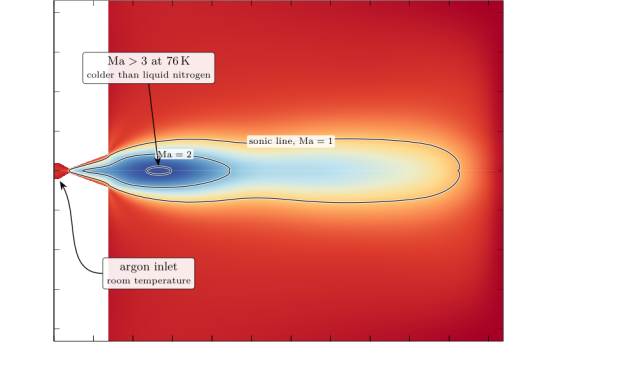
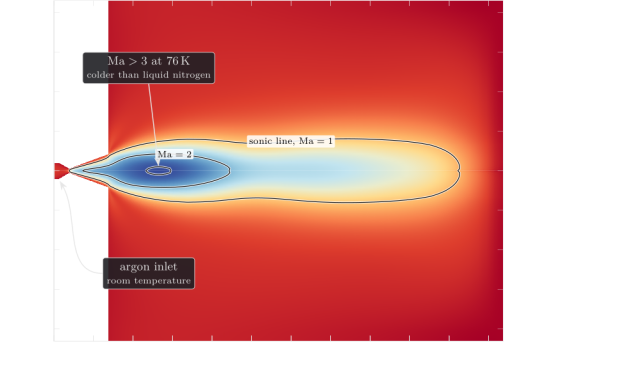
The figure tells the story at a glance. Argon enters the nozzle at room temperature, crosses the sonic line at the throat, and only two centimeters later races at 499 m/s — Mach 3.07, more than three times the local speed of sound. In doing so, the gas cools itself down to 76 K, below the boiling point of liquid nitrogen. No cryostat, no refrigerant: the expansion alone does the freezing, and the deep blue jet carves through the warm background gas until the supersonic pocket closes again ten centimeters downstream.
Closing
Entropy is the stern bookkeeper of gas dynamics, and flows at the edge of technology are exactly where keeping the books becomes hardest. By pairing polynomial entropies with their matching approximate products, we obtain moment methods that are well-posed, exactly entropy-dissipative and, by asymptotic consistency, faithful to Boltzmann's physics. From lithography machines to satellite thrusters, that combination turns a century-and-a-half-old theory into a practical engineering tool. At Simkinetic, we are developing the deterministic solvers that put it to work.